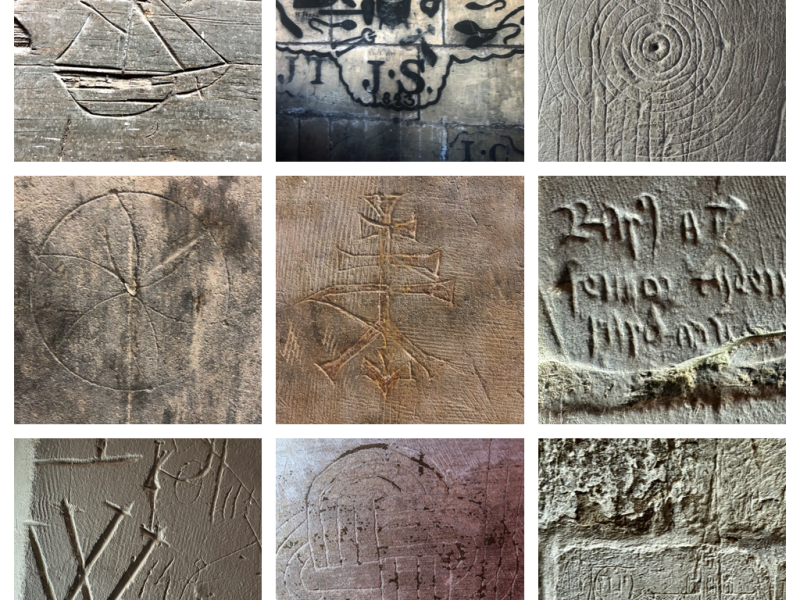
As a historic building conservation company, we are fortunate to work across a wide variety of historic structures — from churches and chapels to halls and barns.
One thing we have consistently found over the years is that almost all of these buildings, regardless of their scale or status, share a common feature: graffiti.
Recently, Salisbury Cathedral announced a new tour focusing specifically on the historic graffiti within its walls — a welcome reminder that these markings are an important part of our heritage.
Graffiti often turns up in unexpected places. Some are as simple as a name and date; others are much more expressive, offering a glimpse into local life and beliefs.
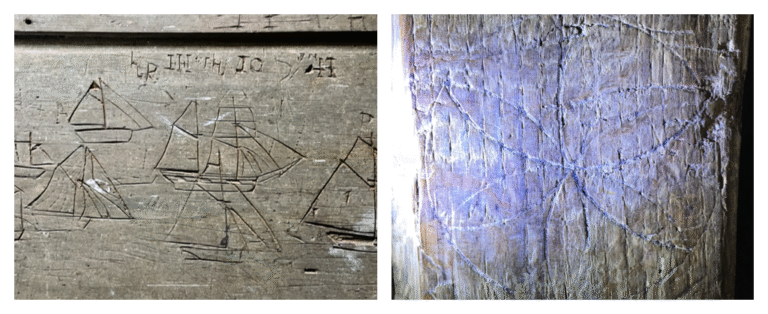
At St Eilian’s Church on Anglesey, for example, while carrying out investigative works, we discovered numerous examples of ship graffiti. On the rood screen separating the nave from the chancel, we also found a hexafoil (or daisy wheel) — a traditional symbol believed to protect against evil spirits.
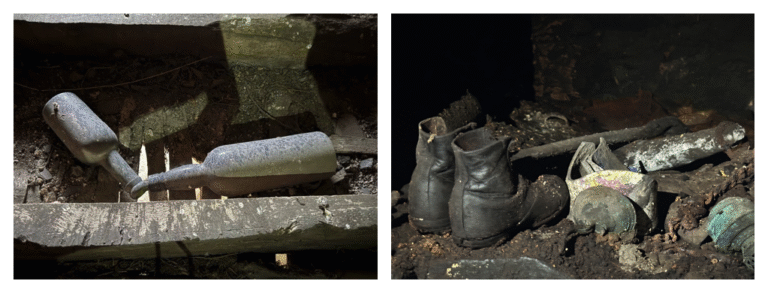
It is not only graffiti that we uncover. On one of our current conservation projects — a medieval timber-framed building in the Vale of Clwyd — we discovered a pair of child’s boots hidden in an inglenook, and bottles sealed away in the roof space. These objects were likely placed as protective charms, giving further insight into the hopes, fears, and daily lives of people in the past.
Taken together, these marks and objects form a vast, informal library across our historic buildings, documenting the experiences, ambitions, and anxieties of ordinary people over centuries.
So what does this mean for a building conservation company like ours? Conservation is not just our work — it is our philosophy. When we come across graffiti or other historically significant finds, we treat them with the same care and respect as the building fabric itself. We carefully record their existence and work around them, applying a principle of minimum intervention. In doing so, we ensure these traces of the past are preserved for future generations to study and appreciate.
Protecting historic graffiti and cultural marks also enriches the story that a building can tell. It allows communities to connect more deeply with their local heritage, fosters pride and understanding, and sometimes even leads to new research and interpretation.
At R Moore Building Conservation, we see ourselves as custodians — not just of stone and timber, but of the hidden stories embedded within them.