
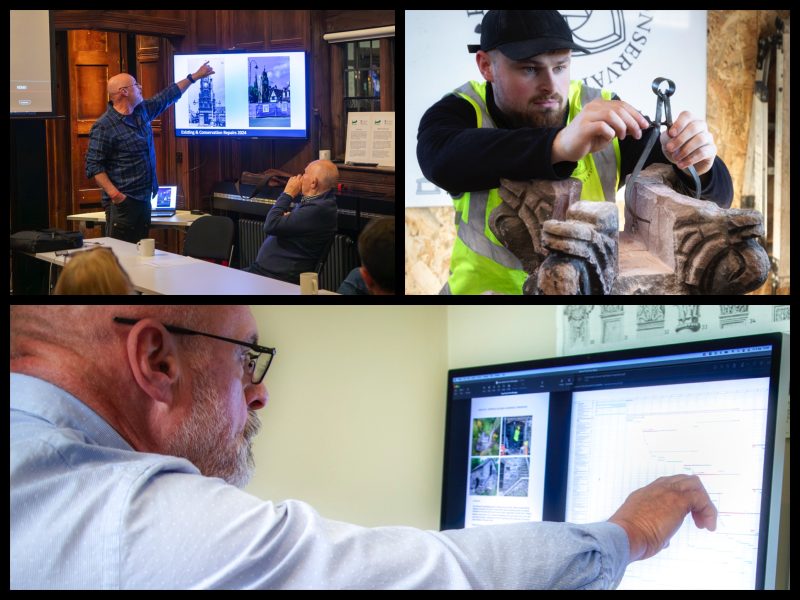
RMB Conservation has expanded its services in-house, complementing the foundation of stonemasonry with a wider range of traditional skills. Our services now include the Reordering of Churches and Project Management. These skills have grown through experience on sites across Wales and the North West of England. They are further supported by a trusted circle of fellow conservation specialists and subcontractors – associates whose work not only complements ours in practice but also aligns with our wider philosophy: that building conservation is as much about care, continuity and respect, as it is about craft.
Stonemasonry is where we begin, but conservation asks for more: the logistics that bring order to complexity, the planning that keeps projects moving, the partnerships that bring trades together, and the patience to listen to what each building needs.
Stonemasonry gives us our foundation. Experience gives us our reach. And with both, we continue to act as stewards of buildings, places and memory – repairing what is fragile and strengthening the ties between people and place.
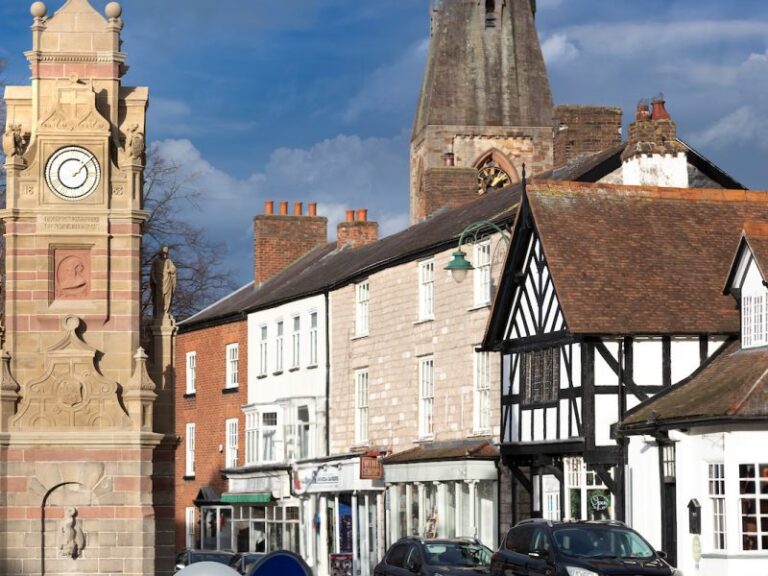
In Ruthin, our comprehensive conservation of the Peers Memorial Clock Tower combined the replacement of stone cornices and dental courses, Thermotec stone cleaning, hot lime pointing, resin and stone mortar consolidation. Re-gilding and restoration of the clock faces, specialist metalwork: Re constructing the wrought iron cross and manufacturing and gilding a new weathervane, replicated from historic photographs. The project was fully scaffolded and wrapped in designs made by local school children. The result isn’t only technical – it’s civic: the town turned out for the reopening, celebrating a renewed focal point in the square.
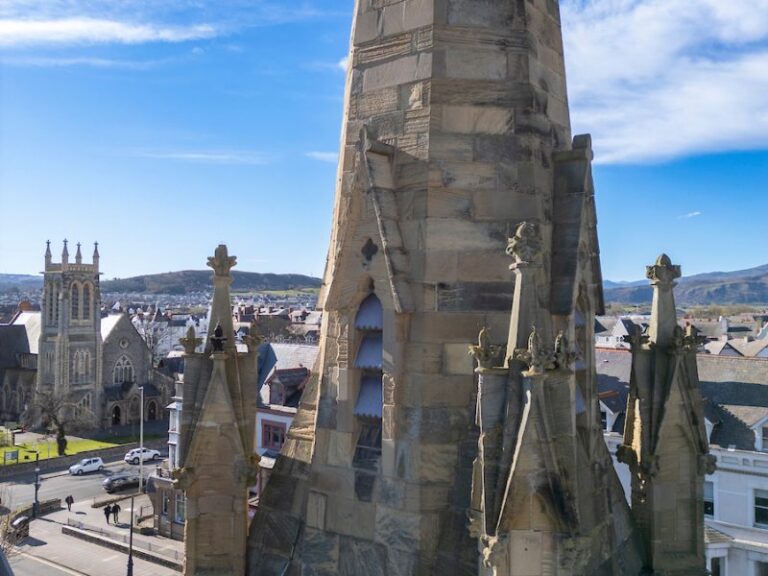
At St John’s, Llandudno, we are carrying out major structural stability repairs to the spire pinnacles. Iron fixings originally used to construct the spire have corroded and expanded over time, causing the pinnacles to become unstable. The works are carried out to best conservation practice. The pinnacles will be rebuilt in hot lime mortar, and any defective carved masonry will be replaced with new stone, to match the existing detail. It’s a methodical dismantle-record-rebuild approach. Selected stones are re-carved; hidden fixings pin the pinnacles; and scaffold keeps Mostyn Street moving while work progresses above.
Further west at St Cedol’s, Pentir, our small-scale preventive actions – addressing cracks, vegetation and open joints – protect the church’s long-term stability, whilst at St Tudclud’s, Penmacho, small fixes with bespoke rainwater goods provide long-term gain.
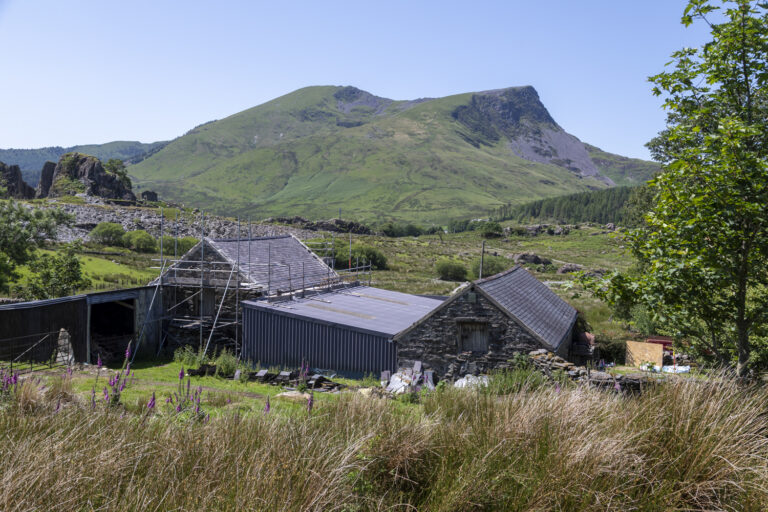
On a 16th-century farmstead in the Eryri National Park, we’ve combined modern construction practices with traditional skills and materials, constructing a new extension, clad in existing stonework sourced from the client’s quarry. Along with under floor heating, limecrete floors finished with slate flagging. M&E upgrade and alteration, freshwater sanitation plant installation, New purpose made joinery including doors windows and stairs. We are acting as project managers splitting the works into phases over the next three years converting stone outbuilding into accommodation.
In the Vale of Clwyd, a Grade II* medieval house is being stabilised through a preservation-led, minimum-intervention approach – treating the building as “standing archaeology only replacing structurally unstable sections of the oak framed structure in this case the complete south gable.
” Elsewhere, in a Grade II timber-framed house in Cheshire, we’ve removed inappropriate cementitious render and reinstated breathable traditional finishes to resolve moisture risks, to the historic timber framing and also to the newly formed and pegged oak timber frame.
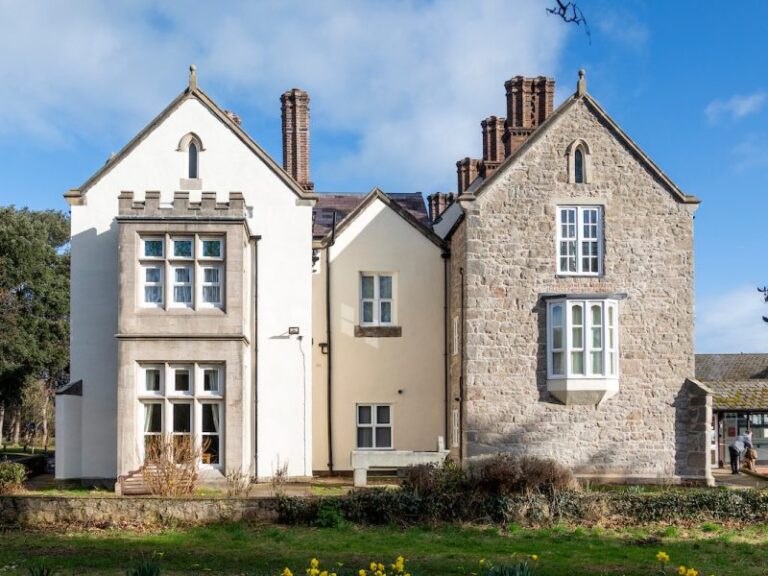
Sometimes breadth means the full mix of trades on one site and the project management skills to suit. At Pentre Mawr House in Abergele, we’ve delivered masonry and chimney repairs, lime rendering, repointing, breathable external decoration, joinery and window work, plus an extensive roof refurbishment – including timber repairs, breathable underlay and relaid Welsh slate.
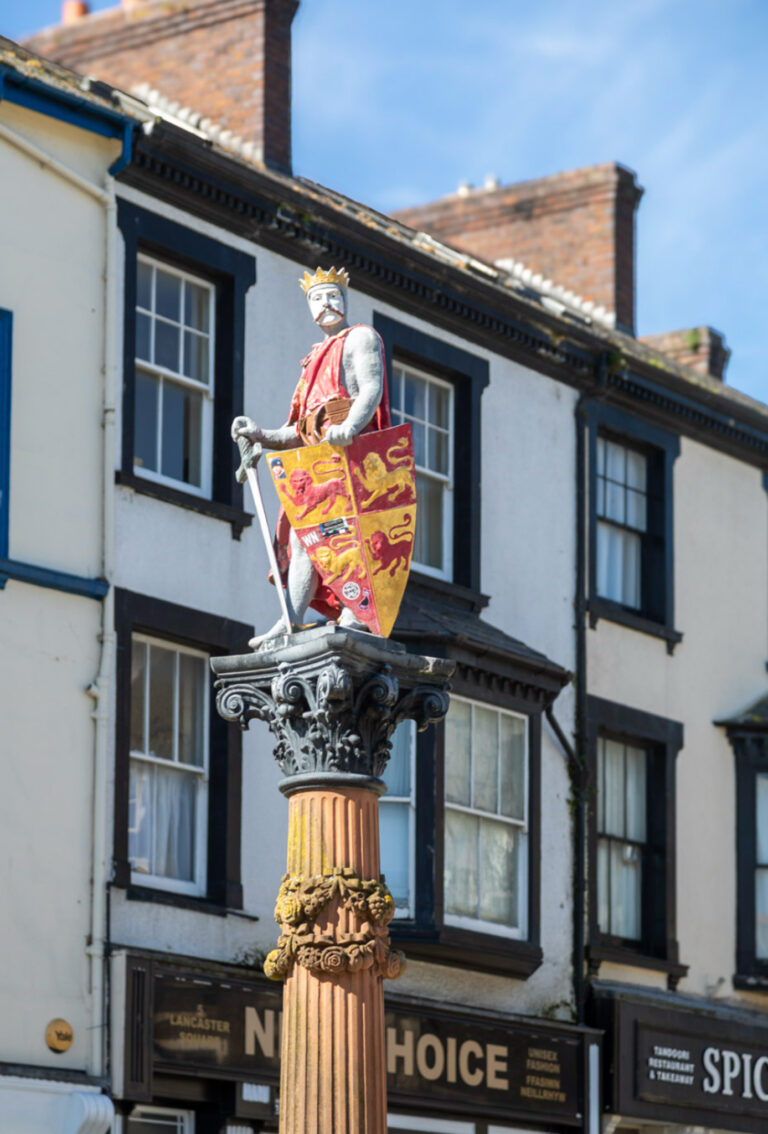
Breadth also means caring for the objects that anchor civic memory. In Conwy’s Lancaster Square, we stabilised the Llywelyn ap Iorwerth monument and repaired its lettered copings. And when investigative work reveals historic graffiti or apotropaic symbols – such as boots or bottles in hidden spaces – we record and retain them under a minimum-intervention philosophy.
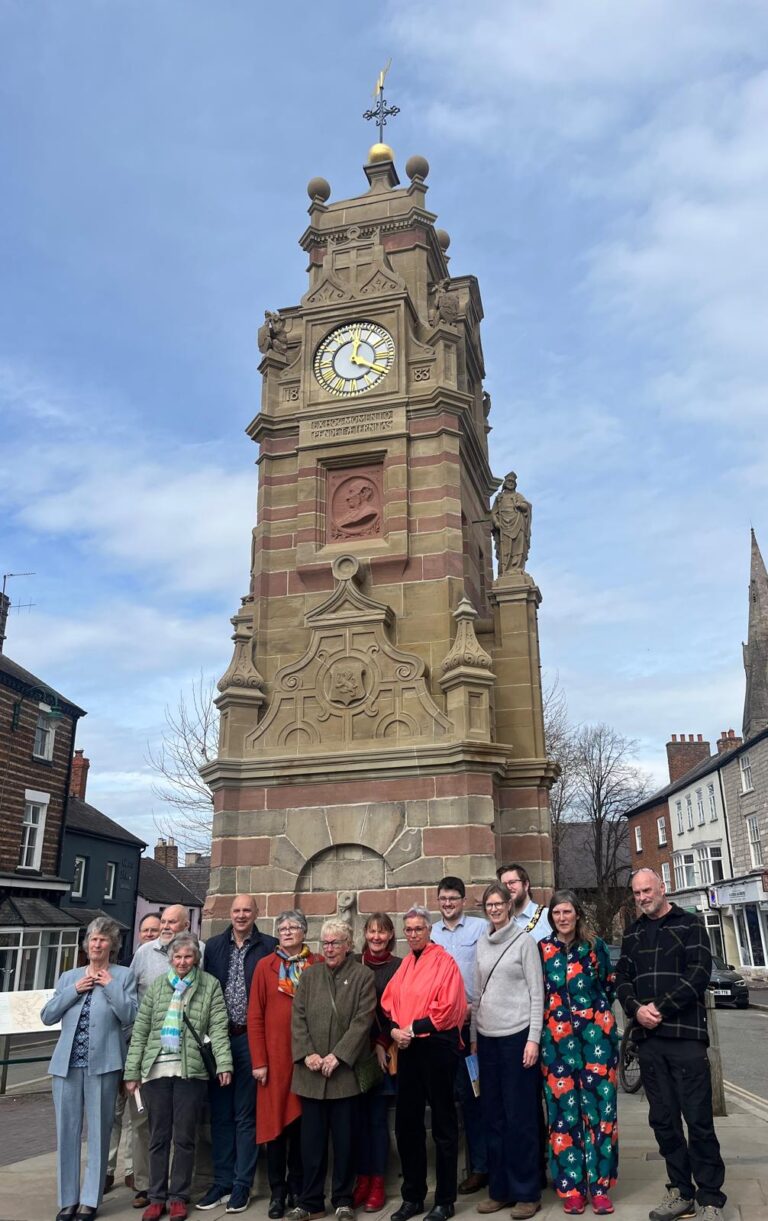
None of this happens in a vacuum. Heritage builds confidence and cohesion. In Ruthin, the clock tower’s return has visibly re-ignited civic pride; our team gave talks, took questions and supported a public programme around the works.(school work experience) Skills are being passed on, too – Rory’s 40-year craft lineage continues through on-site mentoring and an apprenticeship, ensuring the next generation learns the patient, practical ethics that keep historic places alive.